
Who Do We Pray To?
A Dharma Talk

The following was a Dharma talk I gave at the Empty Moon Zen Sangha on Saturday January 24th. I hope you find value you in it.
I want to start with a confession.
A few weeks ago, I found myself doom-scrolling through the news at 10 PM, which is never a good idea, but there I was. Wars in multiple countries. Climate disasters. Political chaos that felt like watching a car crash in slow motion. The murder of Renee Good. The usual litany of things falling apart, amplified by the algorithm’s perfect ability to find exactly what will make you feel most helpless.
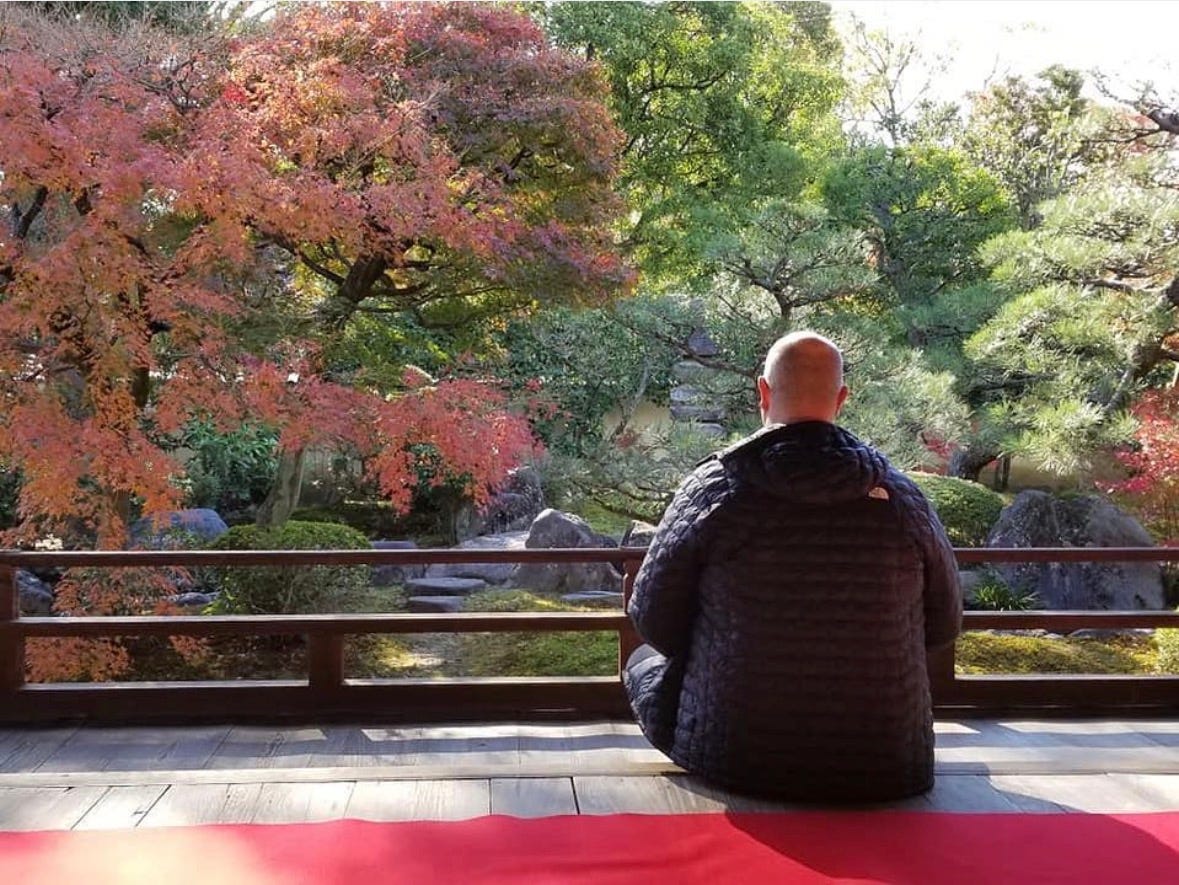
Then I noticed something strange happen. My chest got tight; it often does. I’m used to it now. I know next my breath will get shallow, then my jaw will clench. Pretty standard. But this time was different. It was just too much. And then something happened that tends to happen when it all just gets to be too much. Almost without thinking, my hands started to move into that old familiar position, palms together, fingers pointing up, the way the Sister’s taught us in my CCD classes at the Church of my youth, St. Bonaventure. In these moments of overwhelm it’s not out of the ordinary for this the old Catholic boy to still reach for prayer. Reaching for someone, something, some power greater than myself to please, please make this stop.
It’s in these moments, I will catch myself. Because here I am, a Zen practitioner, a Buddhist, someone who has sat zazen for years, chanted the Heart Sutra more times than I can count, bowed to a lot of empty space, and long ago let go of the notion of a personal God who intervenes in human affairs. And yet, when things got overwhelming, my deepest conditioning went straight to: somebody help me. Please.
Which raises an interesting question, in a religion with no god, no divine intervention, no cosmic Santa Claus keeping a list and checking it twice, who exactly are we praying to?
And more importantly, why do we do it at all?
The History We Inherited
Let me back up and give you some context, because this question isn’t new. Zen didn’t arise in a vacuum. It emerged in 6th-century China, where Buddhism encountered Taoism and Confucianism and local folk religions that were deeply animistic. Then it moved to Japan in the 12th century, where it met Shinto and samurai culture and court aesthetics. At every stop, it absorbed practices that looked a lot like prayer.
In early Chan monasteries in China, monks chanted sutras to “transfer merit” to benefactors, to deceased teachers, to all beings suffering in various realms. They made offerings to Bodhisattvas, Avalokiteshvara, the embodiment of compassion; Manjushri, representing wisdom. They performed elaborate rituals with incense and bells and prostrations that absolutely looked like they were asking someone for something.
In Japan, Zen temples became even more elaborate in their ritual life. They incorporated Shinto practices. They held memorial services for the dead. They chanted to local protective deities. Soto Zen, in particular, developed extensive liturgical forms, lengthy services with multiple chants, dedication ceremonies, memorial rites.
When you read the liturgy we’ve inherited, the Four Vows, the dedication of merit, the names we invoke, it can feel confusing. We say things like “May this practice extend to every being in every realm.” We chant to Quan Yin, asking her to hear the cries of the world. We dedicate merit “to the countless Buddhas and Ancestors throughout space and time.” We invoke the names of lineage holders as if they can somehow hear us across time.
We even have prayers that sound explicitly like petitions: “May all beings be free from suffering. May all beings find peace. May all beings awaken.”
So are we praying? And if so, to whom? To what?
The traditional Zen answer, when pressed on this question, is something like: “Yes and no. It’s not what you think. Don’t make a big deal about it. Now go sit zazen.” Which, while admirably Zen in its refusal to give you conceptual certainty, isn’t super helpful when you’re standing there with your hands in gassho, trying to figure out what you’re actually doing and whether you’re betraying your non-theistic principles or just going through empty motions.
The Function of Prayer
Here’s what I’ve come to understand, both from practice and from studying the tradition. Prayer in Zen isn’t transactional. We’re not bargaining with a deity. We’re not trying to get something from someone more powerful than us. We’re not lighting incense so Buddha will grant us good fortune or protect us from harm. That’s the model many of us inherited from Western religion, prayer as petition, as negotiation, as transaction, but it’s not what’s happening in Zen liturgy.
Instead, prayer in Zen is more like... alignment. It’s a way of orienting ourselves toward what matters most. When we chant the Four Vows, “Beings are numberless, I vow to save them; Delusions are inexhaustible, I vow to end them,” we’re not asking Buddha to save beings on our behalf or to remove our delusions for us. We’re becoming the vow. We’re aligning our whole being with this impossible aspiration. We’re declaring our intention to the universe, to the sangha, to ourselves.
The vows are impossible by design. We will never save all beings. We will never end all delusions. That’s not the point. The point is the orientation, the direction, the commitment to keep moving toward liberation even knowing we’ll never arrive.
When we dedicate merit at the end of service, we’re not sending spiritual currency to some cosmic account where the deceased can cash it in. We’re practicing non-attachment to outcome. We’re dissolving the fiction that our practice is “ours” to keep, recognizing that everything we do happens in a web of interconnection so vast and complex that drawing boundaries around “my” practice or “my” merit is absurd.
When we bow to the Buddha on the altar, we’re not worshipping an external figure who lived 2,500 years ago in India. We’re bowing to Buddha-nature, the awakened potential in all things, including ourselves. We’re acknowledging that awakening is real, is possible, is already here, waiting to be recognized. The liturgy is technology for transformation. It’s a method. It’s not about belief. It’s about practice, about repetition, about letting the words and gestures work on you until they change how you move through the world.
But Who Are We Talking To?
Okay, but that still doesn’t quite answer the question, does it? Because when I felt that impulse to pray while drowning in bad news, I wasn’t thinking about “aligning myself with the interconnected web of all being.” I wasn’t considering the sophisticated philosophical framework of non-dualistic spirituality. I was thinking: Help. Someone, something, please help.
I think that impulse is real and worth honoring. Because it’s human. It’s what we do when we’re overwhelmed, when we’re scared, when we’re grieving, when we’re lost. We reach out. We call for help. Even if we’re not sure who’s listening. And here’s the thing: we are always in relationship. Even in non-theistic Buddhism, we’re not practicing in isolation. We don’t sit alone in our rooms like spiritual hermits, accumulating enlightenment points. We practice in sangha. We chant together. We bow to each other. We recognize teachers and ancestors. We acknowledge lineage. We dedicate merit to those who came before us and those who will come after.
So when we “pray” in Zen, maybe we’re not praying to anyone in the way we might have learned as children. Maybe we’re praying with everyone. We’re joining the conversation that’s always been happening, the conversation between the self that suffers and the self that awakens, between this particular moment of confusion and all of time, between our small human pain and the vast mystery that holds it all.
The Bodhisattvas we invoke? They’re not supernatural beings sitting on clouds waiting to answer prayers like cosmic customer service representatives. They’re personifications of enlightened qualities, compassion, wisdom, vow, liberation. They’re archetypal expressions of what’s possible in human consciousness. When we call on Quan Yin, we’re calling forth compassion itself. We’re reminding ourselves that compassion is real, is present, is available right now. We’re invoking what’s already here, what’s always been here, what we’ve just forgotten in our panic and overwhelm. When we chant to Manjushri, we’re not asking for wisdom to be delivered to us. We’re acknowledging that wisdom exists, that it’s our nature, that it’s accessible if we stop clinging to confusion.
The prayer isn’t a message sent outward to a receiver. It’s a tuning fork. It’s striking a note so we can find the resonance in ourselves.
The Practice of Not Knowing
But I want to be honest with you, I don’t fully understand this. Even after years of practice, there are moments in the liturgy when I wonder what I’m doing. When I’m chanting the names of ancestors I never met, dedicating merit to beings I cannot see, making vows I know I cannot keep, part of me wonders if this is all just theater, just comforting ritual with no substance. And maybe that’s okay. Maybe the not-knowing is part of it.
Zen has always had this relationship with doubt. “Great doubt, great awakening,” the old teachers said. The willingness to sit with uncertainty, to practice without needing to resolve every contradiction, to let yourself be worked on by the forms without demanding they make rational sense, that’s practice too. When you don’t know who you’re praying to, you pray anyway. When you’re not sure if anyone’s listening, you speak anyway. When you can’t figure out if this is spiritually legitimate or just superstitious habit, you bow anyway.
And somewhere in that continued commitment to practice without certainty, something shifts. Not dramatically. Not in a way you can point to and say, “There, that’s the proof.” But you change. The practice does its work.
Working It Out for Ourselves
Ultimately, you have to work this out for yourself. No one can give you the answer to “who are we praying to?” that will satisfy you. Not me, not your teacher, not Dogen or the Buddha himself. Dogen said: “To study the Buddha way is to study the self. To study the self is to forget the self. To forget the self is to be actualized by myriad things.” Prayer in Zen is part of that process.
It’s not about getting the right answer to “who are we praying to?” It’s about letting the question work on you. It’s about standing in front of the altar with your hands together and not knowing, and doing it anyway, until gradually the distinction between prayer and practice, between self and other, between asking and answering, until all of that dissolves.
Some days, you might pray and feel like you’re talking to yourself, just saying words into empty space. Some days, it might feel like the whole universe is listening, like you’re held in something vast and compassionate. Some days, it might feel utterly empty, mechanical, like you’re just going through motions.
All of that is okay. All of that is part of the practice. What matters is that you show up. You put your palms together. You make the offering. You say the words, even when you don’t fully understand them. Even when they feel hollow. Even when you’re not sure you believe them. And gradually, through repetition and sincerity and commitment, the practice does its work. Not because someone is listening and answering. But because you are listening. Because you are answering. Because the prayer and the one who prays are not two separate things.
Coming Full Circle
So back to me, overwhelmed by the news, my body reaching for prayer, my old Catholic conditioning rising up after all these years. I let myself do it. I didn’t have to resolve the theological contradiction first. I didn’t have to figure out who I was praying to. I didn’t have to make it all make sense before I could put my hands together. I just did it. I said what was true, “This is too much. I don’t know what to do. I don’t know how to help.”
And you know what happened? Nothing miraculous. The news didn’t get better. Wars didn’t stop. God didn’t appear in a beam of light to reassure me. No bodhisattva showed up to fix everything. But something shifted in me. The tightness in my chest eased. My breath deepened. I felt, just for a moment, less alone. Less separate from all the suffering I’d been scrolling through. More connected to it, which sounds like it should make things worse, but somehow made things bearable.
Was that prayer? Was it meditation? Was it just my nervous system settling because I’d given it something familiar to do?
Yes. All of it. None of it. Don’t make a big deal about it.
The practice is the answer. Not an explanation of the practice. The practice itself.
So when you don’t know who you’re praying to, pray anyway. When you’re not sure what the words mean, say them anyway. When you can’t figure out if this makes any sense, bow anyway.
Show up. Be sincere. Let the practice work on you.
That’s all there is. That’s everything.
Peace.
After almost 50 years of doing it daily, I bow and pray to the Buddhas, Bodhisattvas and Ancestors. The meaning is in the doing.
I found this helpful and thought provoking. I’ve strayed from agnostic praying to pray, hung up on the theological question, but I’d been benefiting from doing so, from talking aloud, understanding it was to myself. I greatly appreciate you putting all of this to words so well, they hit at just the right moment. We don’t need to resolve the theological question of to whom to pray, because ultimately self is listener and speaker. I am not a Zen practitioner, more of a nondualistic explorer at this point, but I appreciated the history, and learning more about it. Thank you 🙏