
The Narrative Police
On surveillance, shame, and what we do with them in training

Early this week in group supervision one of our newer therapists asked a question that had me thinking. Seriously thinking about something that gets named in whispers among learners, but doesn’t seem to get talked about in the larger narrative training community. In supervision she told me she had been “in her head” during session and that the narrative therapy thing felt hard. That she wasn’t sure she was doing it right. That she felt like she had to ask a narrative question and I could tell there was some frustration happening.
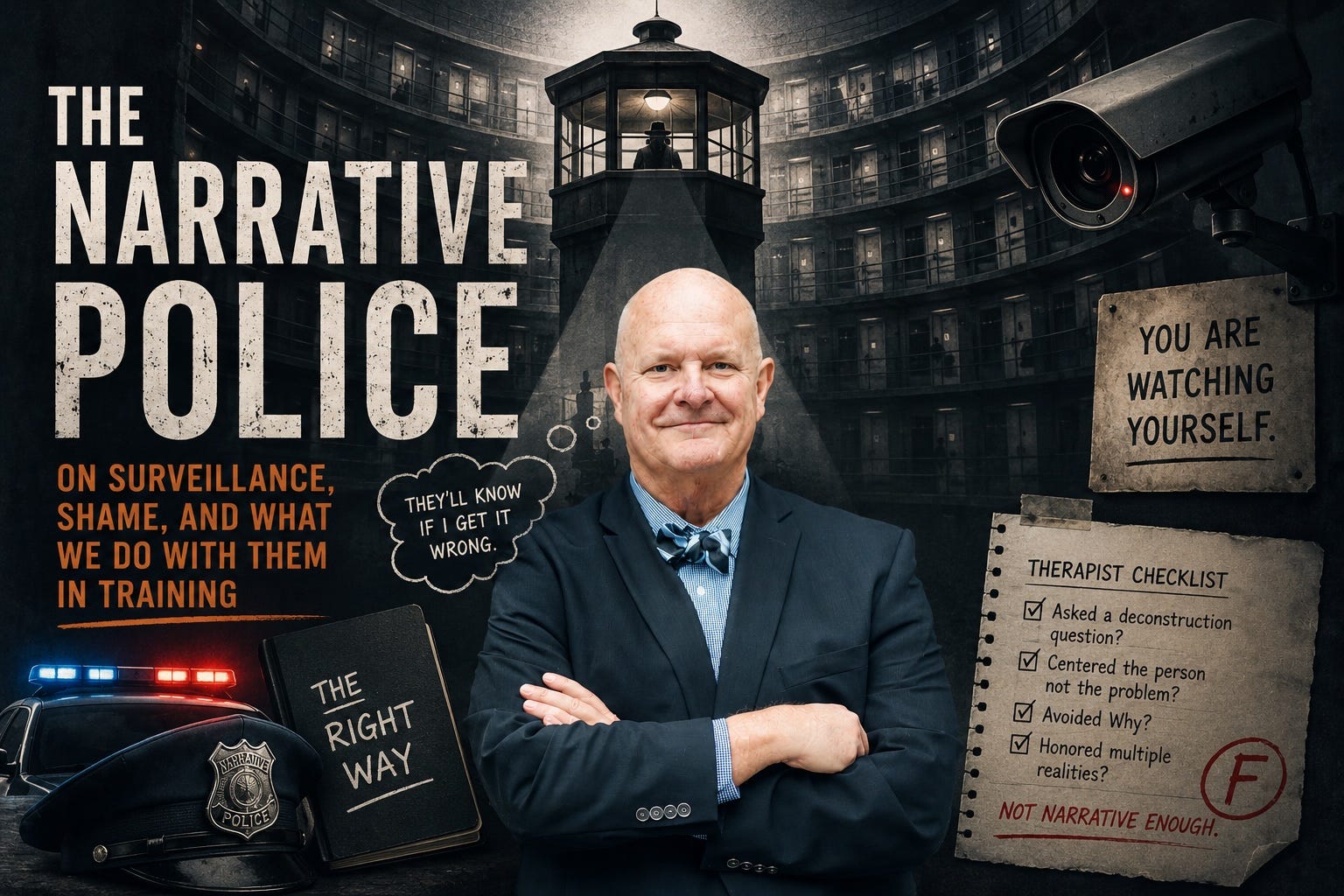
She is a new therapist and is learning one of the harder therapies to learn. But on top of that I noticed the beginning of something I have seen repeatedly. What she was describing, even if she didn’t yet have the language for it, is something anyone who has spent time inside narrative therapy communities knows intimately: the narrative police. That imagined, and sometimes real, audience watching your every move from the sidelines of your sessions. Passing judgment. Keeping score. Making you feel, at best, like you’re failing, and at worst, like you should throw in the towel and go learn something more scripted, more reductive, more certain of itself. Those approaches will remain nameless.
The Awkwardness Is the Work
As she was doing this brave thing to share with me her struggle, I found myself wanting to do two things at once. I wanted to be curious about her experience. And I also wanted to honor her struggle. Because I believe the struggle is meaningful. It is not a bug in narrative therapy training. It is closer to the experience required for this practice.
What I tried to share in the moment was that she is learning a new language, she is learning to listen differently, she is learning that a conversation is not just a conversation. People new to narrative therapy learn quickly that what we say has effects, that the positions we take have effects, that the assumptions we carry into a room have effects. These are disruptive realizations, they are unsettling. Once you understand that language is not a neutral vehicle for transmitting meaning but a site where meaning, identity, and possibility get produced or foreclosed, you cannot go back to treating talk as transparent. Reasons why I still believe in talk therapy.
So yes. When you begin the narrative therapy path, it is going to be awkward. There is no escaping it. The awkwardness is the sign that something is actually shifting. The appropriate response to that awkwardness is not reassurance that it will go away, nor shame that it is present. The appropriate response is something closer to accompaniment. We are in this together. This is what it looks like to take language seriously.
The Long History of the Police
The narrative police is not a metaphor I invented, and anyone who has been around long enough knows that. It has a real history. Narrative therapy, like any intellectual and clinical tradition that develops through communities of practice, has also developed its factions. Its schools. Its cliques. Its unspoken hierarchies of correctness.
Michael White used to enjoy deconstructing the idea of “human nature.” He had a kind of playful skepticism about any claim to an essential human core that sits underneath culture and history and relationship. (As I understand it, when he was coming up in the early postmodern days, being accused of being an essentialist was the worst.) But I think there is something that functions like human nature inside communities organized around ideas. Something that produces insiders and outsiders. A thing that turns a way of working into a way of belonging, and belonging into a way of excluding.
I have been in and around enough different narrative therapy groups to know this. There are conversations that happen. There are the right words to say and the wrong ones. There are the lineages that confer legitimacy and the ones that do not. There are figures you cite and figures you quietly omit. This is not unique to narrative therapy, of course. It is the social life of any tradition. What makes it confusing is that narrative therapy, with its explicit commitment to power analysis and transparency and the deconstruction of normative judgment, has a particular responsibility to examine what it does with this. Unfortunately it often doesn’t.
The external police, the human one made of other people’s opinions and community membership games, is worth naming. But I want to focus on something more insidious. Something that does not require an actual audience.
Biopower in group supervision
Unfortunately, as narrative therapists we are not immune to the sort of power operations that the many people that seek are help are subject to. Michel Foucault’s concept of biopower does a good job of describing how power operates in group supervision, and modern societies. Foucault asserted that power no longer works primarily by the sovereign’s sword, by punishment and the threat of death. It works instead through normalization. Through the production of norms that categorize, measure, and rank. Through the creation of an ideal against which every actual life and practice is found wanting. What makes biopower so effective is precisely that it does not need an external enforcer. Once the norm is internalized, we become our own surveillance. The gaze moves inside. We watch ourselves. We compare ourselves against other therapists. We measure ourselves, and find ourselves, repeatedly, ultimately insufficient. Not quite there yet.
This is the more insidious narrative police. Not the community or the school or the faction, though those are real enough. This is the police that operates in the experience of a new therapist sitting with a client at 2 o’clock on a Tuesday afternoon, monitoring her own performance in real time, adjudicating every response before it leaves her mouth. This is the police born out of training cultures that, often without meaning to, have transmitted idealized images of what a narrative therapist looks like, sounds like, and is.
And it is worth asking: where does that image come from? How does it get transmitted? Who does it serve?
How It Gets Born
I do not think training programs set out to produce this. I’m not happy about it showing up at California Family Institute. The last thing I want is for someone who is training with me to feel surveilled and inadequate. But the mechanisms that produce it are real, and they operate even when no one intends them. Including me.
The first mechanism is the idealization of exemplary practice. When training relies heavily on demonstration, on watching a master at work, on analyzing recordings of elegant sessions in which everything unfolds with beautiful coherence, it inadvertently installs an image of what narrative therapy looks like when it is working. That image then becomes the standard against which the learner measures her own fumbling, stumbling, and real-world attempts. The comparison is not just unfair. It is structurally designed to produce failure. The master’s session has been selected precisely because it is extraordinary. The learner’s sessions are ordinary. That is not a moral failure.
Side note: When I keynoted the AFTA conference several years ago on Rupture and Repair in Therapy I showed work where I screwed up. Bad work. Work that had to be repaired. I remember after how many folks spoke of my courage to show bad work after the talk. Everybody was so used to seeing the extraordinary. A post for another time.
The second mechanism is the conflation of performance with value. When the emphasis in training falls heavily on what questions to ask, on the particular form of narrative inquiry, on identifying whether a move was externalizing or double-listening or scaffolding, the implicit message is that the practice lives in the performance. That if you get the performance right, you are doing it right. That if you fumble it, you are not yet there.
The third mechanism is what I would call the problem of invisible permission. Narrative therapy involves a sustained commitment to curiosity, to not-knowing, to positioning oneself as genuinely uncertain about the meaning of another person’s experience. But in training, the trainee is rarely given explicit permission to not know. To be in the middle of a session and simply not know what to do next, and to stay there without catastrophizing. The message, delivered implicitly through the structure of supervision and evaluation, is that the good therapist knows. That confusion is a deficit. That if you are lost, you have failed.
Making It Visible
I am learning that the first step in taking a position against the narrative police is to make it visible. Not as a personal flaw in the trainee, not as evidence that she is not suited for this work, but as a cultural production. Something that was made. Something that is sustained by specific practices and structures. Something that can be examined.
This is where Foucault is useful rather than just performative. If the police are not a natural response to learning but a product of how learning has been organized, then the training context itself becomes an object of inquiry. We can ask: what norms are operating here? What images of the ideal practitioner are circulating? Who installed them? What do they foreclose?
In supervision and mentorship, this means being willing to turn the lens. Not just on the trainee’s practice but on the context that is producing a particular relationship to that practice. On me. When a trainee tells me she was in her head during session, I am not interested only in what happened in the session. I am interested in what audience she was performing for, and where that audience came from, and what they were saying.
In an effort to diminish the narrative police at CFI, my coauthor of our new forthcoming book Contemporary Narrative Therapy Lindsey Hampson and I are bringing a Fish Tank Mapping conversation into CFI this month. Lindsey, a clinical psychologist in the UK, developed this chapter and this practice as a way of helping systems, schools, teams, families, slow down and look at the wider waters they swim in rather than fixing attention on any one fish. She is calling hers The Waters We Swim In, and the questions are organizational versions of the same inquiry I am describing here. What are the dominant stories within our organization. What values and assumptions shape our work. What supports people to flourish. What pressures or constraints influence practice. What aspects of our culture have become so familiar that we no longer notice them. The point is not to evaluate anyone or produce a tidy account of CFI. It is to make the invisible visible enough that we can look at it together, staff and trainees and leadership in the same room, and ask what conditions are producing the experience people are having here. If the narrative police are a cultural production rather than a personal failing, then the culture itself has to be willing to sit in the fish tank, together.
Taking a Position
Taking a position against the narrative police does not mean pretending it does not exist. It does not mean reassuring trainees that their work is fine when it needs attention. It does not mean abandoning rigor or reflection or the serious practice of noticing what we are doing and why.
It means taking a position against the particular form of judgment that the police specialize in. The judgment that says you are not yet a real practitioner. The judgment that measures your worth against an idealized image of the perfect narrative therapist. The judgment that treats the messiness of learning as evidence of inadequacy rather than as the actual experience of learning. It means building training cultures that are capable of appreciating the struggle. Not just tolerating it, not just managing it, but genuinely appreciating it as the sign that something real is happening. That a person is being changed by what she is learning. That the awkwardness is fidelity, not failure.
It means being curious about the police themselves. When a trainee reports feeling watched and judged, that is not a problem to be solved with encouragement. It is an invitation to an inquiry. What does the police tell you? Where did they get their authority? What do they say happens if you don’t listen? What has it cost you to have them as a constant companion in your sessions?
And it means making visible, in training contexts, the difference between accountability to an approach and ethic, or submission to an image of purity. Narrative therapy has commitments. Those commitments are worth being accountable to. But accountability to a practice is not the same as surveillance by an ideal. One is an ongoing, relational, contextual process of reflection and return. The other is a machine. A machine that never turns off, never says enough, and never lets you forget that you are not the exemplar in the recording.
A Word About the Traditions
I am aware that what I am writing here will be recognizable to some people as itself a move within the politics of narrative therapy communities. That by naming the factions and the schools and the cliques, I am taking a position inside a contested field. That is true. I am not attempting neutrality. Neutrality is not available, and pretending to it would be its own kind of dishonesty.
What I will say is this: the best of what narrative therapy offers, the genuine intellectual and ethical core of what White and Epston and the people who followed them who built this tradition were trying to do, is not a set of techniques that can be policed into correctness. It is an orientation toward people, toward their knowledge and their agency and the stories they are living inside. An orientation that takes power seriously. That takes language seriously. Takes the political seriously. That takes the effects of practice seriously.
If that orientation produces anything, it should produce training cultures that are capable of the same. That can look at how power operates inside their own communities. That can ask what stories about practice they are transmitting, and who those stories serve, and whether they are the stories they actually mean to tell.
The young therapist who was in her head during session, that is not a problem. She is learning something real about this work. The question worth asking is what she is learning it inside of. And whether that context is doing justice to the difficulty, and the beauty, of what she is trying to become.
Peace.
(PS. I did ask her to read this, for approval, before posting.)
Come be in composition.

Not a conference. A salon.
Three days of provocative keynotes, intimate dialogue, and live art with therapists, cultural workers, and thinkers pushing beyond the usual scripts.
Tired of boring conferences? This is your moment.
Dangerous Stories: A Therapy Salon
October 1–3 · Irvine, CA
This is where therapy stops playing it safe.
(All funds support California Family Institute, CEU’s available!)
🎟 Grab your spot: https://www.californiafamilyinstitute.org/dangerous-stories/
Thank you for the reflection Chris. This is a question that has captured me as a person who struggles to do narrative therapy myself. I would submit that the Narrative Police experience is connected to a larger cultural project of "Being a good western student". I'm currently teaching for USF's MFT program in the south bay and the question of "am I doing this right?" comes up on a regular basis. Am I doing Intake right? Am I writing this clinical formulation right? Am I answer these questions right. Every time a student wears the face, "I'm afraid to share my thought because I'm not sure its what Brian is looking for" I immediately ask the student to wonder what the expectation is that is intimidating them into silence. Its becoming a running joke with the students. I've come to take seriously the naming of this style of self-policing (self-disciplining) with my students on behalf of encouraging them to foster their personal curiosities as a professional helper entering a field that has lost interest in the therapist as a person.
I submit the narrative-police is a kind of "special unit" of policing that specializes in reminding those of us practicing narrative therapy that we run the same risk of embarrassing ourselves if we dare being something other than some kind of resident expert.
i realized the narrative police showed up... and prevented me from writing a longer comment. I often think of the idea of policing and how it shows up in the most subtle and sneaky ways... haha for me and I and from what i have learned it shows up for others I consult with.. I'll have fun reading this and listing to this again. thanks again for exposing this, and offering it in such a palpable way.