
The Difference Between Producing and Creating
Arturo Escobar, Al-Anon, and Letting Go of the Need to Be Right

You who are on the inside, don’t condemn my lack of faith too quickly; you who are on the outside, don’t be too quick to mock my overcredulity; you who are indifferent, don’t be too quick to wax ironic about my perpetual hesitations. -Bruno Latour
There is a particular criticism that I have faced as someone spends much of their life trying to make things. It is the suggestion that my producing, publishing, teaching, recording, organizing, or building is ultimately a form of insecurity. That the need to contribute is really the need to be seen. That my productivity is another treadmill, powered by the approval of strangers. I have a friend often puts it to me this way. She believes my consistent creating reflects an attachment to what others think. From her perspective, the wiser and better path is one of greater detachment from the endless pressure to produce.
It is not an inaccurate critique. There have been periods when my work has become entangled with exhaustion. I have found myself doing the next article, the next podcast, the next workshop, convinced that one more project would finally produce a sense of arrival. There have also been disappointments when work I thought was good seemed to disappear into the algorithmic void, raising questions about whether any of it mattered at all. Burnout and failure have a way of exposing motivations that success hides.
At the same time, I don’t believe that the answer is simply to stop making things. Creating has never felt primarily like self-promotion. It has been a way I think it out. The way I work clarifies ideas that otherwise remain blurry. Teaching forces me to test concepts against lived experience. Podcast conversations have introduced me to people I would never have otherwise encountered. Even collecting books has become less about possessing them than about participating in an ongoing conversation. Creating, for me, is not the accumulation of outputs. It is a way of participating in the world.
Maybe the better question is not whether we create, but what relationship we have with our creations. It is here that I find myself influenced by Arturo Escobar’s critique of what he calls the “One-World World.” Escobar argues that modernity repeatedly assumes there is a single correct way of living, organizing society, pursuing knowledge, or imagining progress. Alternative ways of being are tolerated only insofar as they resemble this dominant model. The problem is not simply political. It is existential. We begin to believe there is one right future toward which everyone should live.
I recognize this tendency in myself. It has often appeared in more subtle forms than political ideology. As a therapist, teacher, and creator, I have frequently carried assumptions about how people should change, what constitutes a meaningful life, or which intellectual traditions deserve more attention. Critical theory itself can become another universalizing project, dividing the world into those who “get it” and those who remain trapped in false consciousness. One does not need to be dogmatic to quietly assume that one’s own map is the one others ought eventually to adopt.
Escobar offers something different. Rather than imagining a single destination, he invites us into what he calls the pluriverse: a world in which many legitimate worlds coexist. The point is not relativism, where every idea becomes equally persuasive, nor is it the abandonment of ethical commitments. It is the recognition that our own preferred ways of living remain situated, partial, and historically contingent. Other people are composing lives according to different histories, different obligations, and different visions of what flourishing requires.
Funny enough, I have found an unexpectedly similar lesson in Al-Anon. One of its enduring pieces of folk wisdom is the reminder to “stay in your own hula hoop.” The image is wonderfully ordinary. My responsibility is not to step into everyone else’s circle, rearranging their choices or correcting their trajectories. My work is to remain accountable for my own actions, my own responses, and my own values. It is a practice of humility cloaked as common sense.
That idea alongside Escobar’s has the metaphor take on additional depth. If there are many legitimate ways of inhabiting the world, then perhaps my task is not to recruit others into mine. I can still teach, create, and advocate for the ideas I believe matter. But I can hold them more lightly. I can offer them up tentatively rather than impose. I can be invitational rather than convincing. My work becomes an opening into conversation rather than something that requires agreement.
Ironically, loosening my grip on how others should live has also changed my relationship to my own work. I feel less compelled to measure its success through influence or recognition (or critique). The value of creating lies in the act itself. An essay may influence another person’s thinking, or it may not. A podcast episode may disappear into the vast empty of the internet. A workshop may alter someone’s practice in ways I will never witness. Those outcomes matter, but they no longer define the worth of the effort.
This has also lightened up another tendency that has been around for years: judgment. It is easy, especially within intellectual communities, to develop elaborate explanations for why other people are mistaken, politically naïve, theoretically unsophisticated, or ethically compromised. Sometimes those critiques are accurate. Often they become a way of protecting our own certainty. Staying inside my own hula hoop has not required abandoning critique. It has required remembering that critique is not the same as stewardship. I am responsible for my own practice before I become responsible for anyone else’s.
I imagine my friend and I will continue to disagree. She may still see my life as unnecessarily busy, overly public, or attached to production. I understand why. Her criticism continues to ask something important: Who am I creating for? That question deserves to be asked. But I no longer think the answer is to stop creating. The better question is whether I can create without trying to manage what my creations become. Whether I can let them into the world without hoping they persuade, succeed, or justify my existence. That, I suspect, is a healthier form of freedom.
I suppose this is true even of the tools we use. I have increasingly found myself working alongside AI, and I know that choice invites its own judgments. Some see collaboration with these tools as evidence that the work is no longer genuinely yours. My responsibility is not to persuade everyone that collaborating with AI is legitimate. It is simply to remain accountable for how I use it, what I make with it, and whether it enlarges or diminishes my participation in the world. The question is not whether a tool is pure. The question is whether I remain accountable for what I make with it.
All this to say that I think the real distinction is this. Production seeks accumulation. More articles. More podcasts. More followers. More recognition. Creation is something else. Creation is participation. We borrow ideas, reshape them through our own lives, and return them to the commons in the hope that someone else might find them useful.
If I have learned anything from Escobar and from the wisdom of Al-Anon, it is that these two commitments belong together. I can participate without insisting that others participate as I do. I can create without believing my way is the way. I can stay inside my own hula hoop while appreciating that countless other ways of being in the world that are beside mine. That feels less like I’m stuck in production and more like gratitude. And less like I’m trying to build a legacy and more like joining a conversation. And I think that has been what I have been trying to do all along.
Peace.
PRESENTER ANNOUNCEMENT
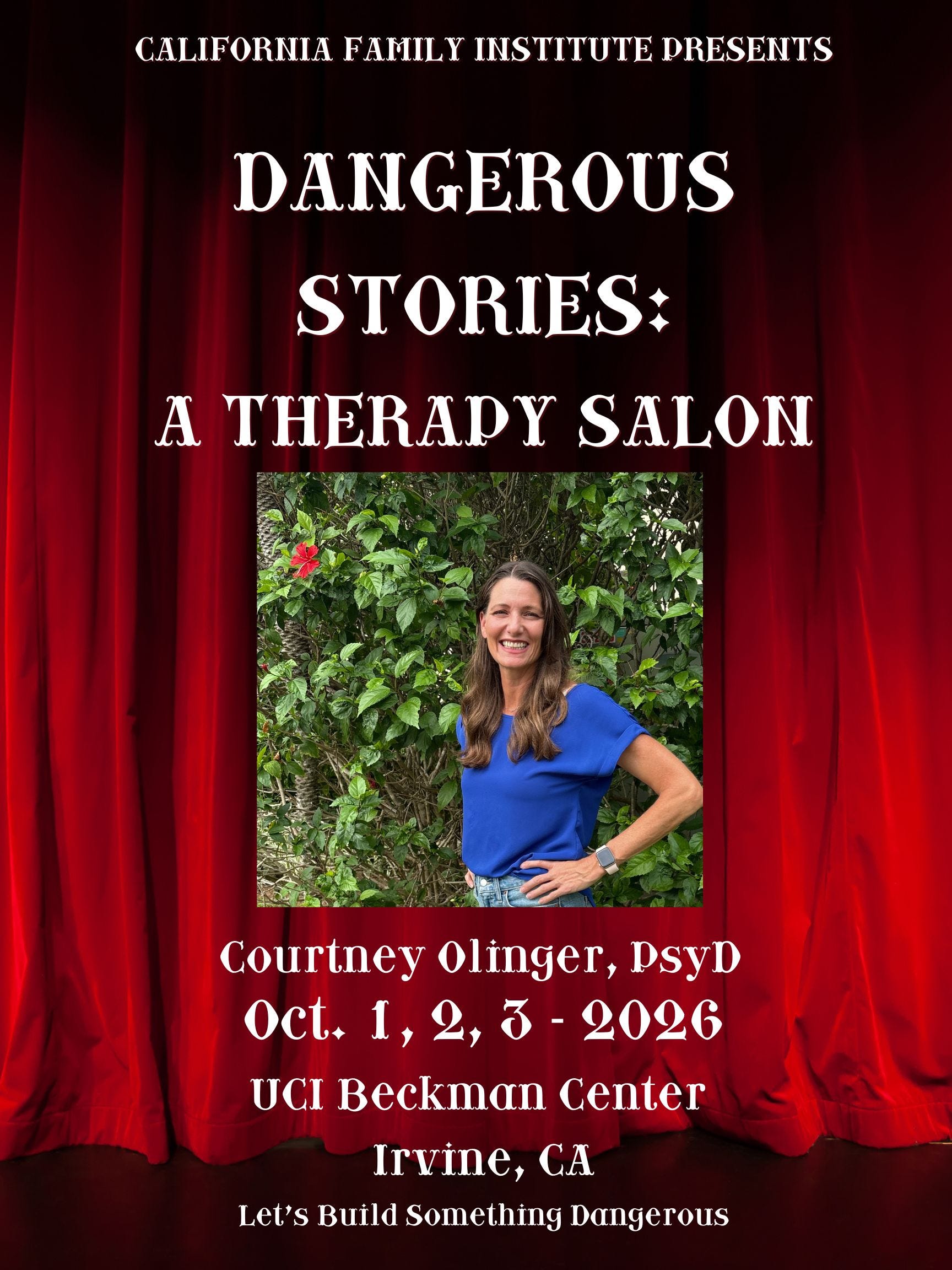
Courtney Olinger, PsyD
I’m Not Going to Give You a Map: Wayfinding in Neurodivergent Worlds
Therapists love maps. Treatment maps, developmental maps, social skills curricula — the whole apparatus of charting the “right” path. And for autistic and other neurodivergent people, those maps have mostly been drawn by someone else, to someone else’s territory, measured against neuronormative expectations they never agreed to.
Courtney refuses to hand you one. That’s the point.
Courtney has worked alongside autistic individuals since 2000. She holds a doctorate in Marriage and Family Therapy, trained in narrative therapy through the Dulwich Centre in Adelaide, and authored a landmark three-part series on narrative practices and autism in the International Journal of Narrative Therapy and Community Work — work explicitly aimed at shedding ableism from therapy. She brings lived experience as well as clinical experience, and a career-long practice of privileging insider knowledges over professional prescriptions.
At Dangerous Stories (October 1-3, Irvine), Courtney offers wayfinding instead of mapping: attending to sensory cues, environmental landmarks, and relational practices that open therapy to people’s own knowledges and preferred ways of being. Through clinical stories spanning productivity, expectations, OCD, suicidality, and intersectionality, she’ll reflect on practices that resist replication as formula — and show us what to become curious about, how to travel alongside people, and how to stop reproducing neuronormative assumptions in our work.
No map. Better questions.
More speakers coming.
Registration open: https://www.californiafamilyinstitute.org/dangerous-stories/
Let’s build something dangerous together.
Thank you for this definition of creation! I love to take in ideas, process them, and this gave me some courage to publish without expectation.
The older I get the less concerned I am with why I do what I do - or with other people’s critiques of my creativity. Those critiques may themselves be critiqued and voila we have an argument.
Like you, I tend towards making things: businesses, workshops, essays, classes. I will be the first to tell you that this drive originated in my childhood terror of being overlooked and forgotten. Like all behaviors rooted in trauma response this one has a dark and a light aspect. The light aspect is that I’m very good at organizing, initiating, facilitating, leading. The dark aspect is that I can sometimes equate my value as a human to the outcome of what I create - real or perceived (by me).
How I balance the dark and light is my business until it begins to affect others negatively, at which point critique is useful and deserved. I have come to a place in my life where I recognize the people who know me well enough to call out my darkness when it appears. They are angels. And when they speak, I listen.