
Relational Imagination
A Poststructural Ethics of Family Estrangement

Just this week I sat with someone reflecting on their relationship with their now deceased parents. We spoke about the harm that had taken place in those relationships and the ways they still influence their life. And, alongside the anger, grief, and disappointment was something I see often in my work. Love was still there. Not uncomplicated love. Not love that excused what had happened. Just love. Over the years I’ve come to recognize this as one of the unacknowledged experiences people bring into therapy. It isn’t always a question so much as a wondering. How can I still love someone who hurt me so deeply? The complexity of these experiences is not lost on me.
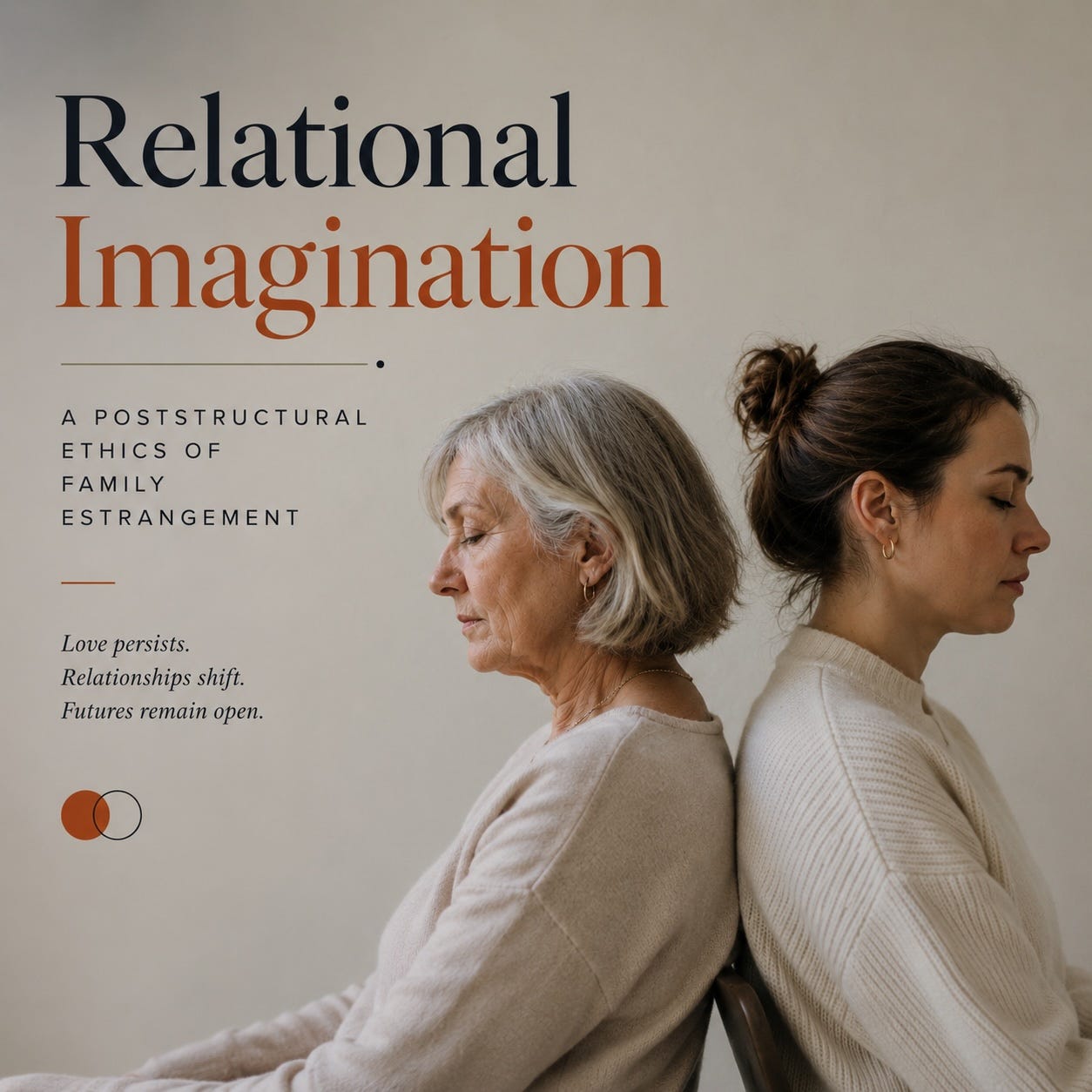
A recent Wall Street Journal article asked an attention getting question: Are therapists to blame for the rise of adults cutting off their parents? It is a question that reflects a broader cultural conversation that has become difficult to ignore. Family estrangement, once treated as a private tragedy or a source of quiet shame, is now discussed openly in therapy offices, podcasts, memoirs, and across social media. Some see this development as long overdue. Adult children who experienced abuse, neglect, or chronic invalidation have found language for experiences that previous generations often had to endure in silence. Others worry that therapeutic culture has become too quick to frame estrangement as a milestone of psychological health, leaving little room for ambiguity, repair, or the ordinary complexity of family life.
Like so many contemporary debates, the conversation quickly splits into opposing camps. Either estrangement is viewed as liberation, or it is viewed as evidence that therapy has encouraged people to abandon their families too easily. I think both positions miss something important.
The question that interests me is not whether estrangement is justified. In many situations it absolutely is. Nor am I interested in defending reconciliation as some higher moral achievement. Reconciliation without accountability has never struck me as particularly ethical. Instead, I find myself wondering whether the debate itself has become trapped inside a framework that offers only two imaginable futures: remain in relationship or leave it. Once those become the only available possibilities, therapists inevitably find themselves helping clients decide between competing moral positions rather than exploring the much larger landscape of relationships that might still be composed after harm has occurred.
One of the contributions of poststructural thought is its suspicion toward fixed categories. Rather than asking what family is, it asks how family comes into being through discourse, culture, institutions, obligation, memory, and everyday practice. Family is less a natural fact than an ongoing accomplishment. It is continually composed through conversations, rituals, loyalties, expectations, silences, and shared histories. The same might be said of estrangement.
It is tempting to think of estrangement as the absence of relationship, but in practice it rarely functions that way. Silence organizes relationships. Distance organizes relationships. Refusing contact continues to shape lives just as surely as maintaining contact does. Even after decades of separation, people continue dreaming about parents, grieving them, worrying about them, or quietly imagining conversations that may never happen. Estrangement is not the end of relationship. It is one form that relationship can take. I think this shift in perspective has important implications for therapeutic practice.
Much of contemporary clinical discourse remains organized around values of autonomy, boundaries, differentiation, and self-protection. These have been seen as correctives to generations of minimizing abuse or demanding unquestioning loyalty in the name of family. Yet every conceptual advance has its own shadow. If autonomy becomes our only organizing value, relationships begin to appear primarily as matters of individual choice rather than historical, cultural, and ethical inheritances. We risk replacing one simplified moral story with another.
This is one reason I have always appreciated Michael White’s work was because he resisted reducing people to singular identities. No one was simply a victim or simply a perpetrator. Lives were always more complicated than the dominant stories available to describe them. Allan Wade’s response-based work similarly reminds us that violence is never the whole story. Even under conditions of abuse, people are continually responding in ways that preserve dignity, protect others, maintain hope, and resist domination. These perspectives make it difficult to accept the neat moral categories that often dominate public discussions of family estrangement. They encourage us to remain curious about the complexity of people’s responses rather than confident in our conclusions about what healthy relationships are supposed to look like. What continues to strike me, however, is how little attention we give to the persistence of love.
Children frequently continue loving those who frightened them, neglected them, manipulated them, or abused them. This should not surprise us. Long before a child can evaluate a parent’s behavior, their life has already become organized around that relationship. Jennifer Freyd’s work on betrayal trauma helps explain why preserving attachment to an abuser can itself become a strategy of survival. From this perspective, loving someone who caused profound harm is not evidence that something has gone wrong.
This reality is uncomfortable because it resists the moral clarity our culture increasingly demands. We are encouraged to sort people into categories that make ethical decisions feel obvious. Unfortunately lived experience is rarely so cooperative. Love often survives where trust cannot, and compassion sometimes emerges without reconciliation.
Australian Alan Jenkins extended this conversation in a way that I think has relevance for the current debate. Rather than asking only how those who have been harmed might recover, Jenkins asked what accountability requires of those who have caused harm. His work refused both condemnation and absolution. Accountability is not reduced to confession, remorse, or emotional displays of regret. Nor is it measured by whether someone is eventually forgiven. Accountability is a sustained ethical practice. It involves accurately naming one’s actions, acknowledging their effects without minimization, respecting the autonomy of those who have been harmed, making restitution where possible, and accepting that reconciliation may never occur. Responsibility, in Jenkins’ work, is not something one achieves. It is something one continues to practice.
I think this is important when thinking about family estrangement. Public conversations often assume that relationships move toward one of two endings. Either the adult child returns, or the relationship remains permanently severed. Jenkins invites a different way of thinking. Accountability does not determine the future of a relationship, but it does transform the ethical conditions under which different futures become imaginable. A parent may become deeply accountable while an adult child still decides that no further relationship is possible. That decision can itself be ethical. Another parent may demonstrate years of accountability, respect boundaries, stop denying the past, and gradually participate in building a relationship that bears little resemblance to the one that existed before. Neither outcome should become our preferred therapeutic ending. Both represent different responses to different histories.
This is where I find Bruno Latour’s distinction between critique and composition helpful. Latour argued that critique, valuable as it is, eventually reaches its limits. Once we have identified structures of domination, exposed myths, and named injuries, we are still left with a practical question: What shall we build now? Arturo Escobar poses a similar challenge in his writing on the pluriverse. The goal is not merely to dismantle inherited worlds but to participate in composing different ones. Both thinkers redirect our attention from judgment toward creation, from exposing what has gone wrong to participating in what might yet become possible.
These ideas have profound implications for how we think about family estrangement. If our therapeutic imagination remains organized around the binary of reconciliation versus estrangement, then every conversation becomes a debate over which ending is morally preferable. This sort of conversation assumes there are only two ethical futures available to people whose lives have been shaped by harm. A poststructural perspective encourages us to question that assumption. Relationships are not static entities that are either preserved or destroyed. They are continually being composed and recomposed through history, accountability, memory, boundaries, absence, care, and changing forms of participation.
All this leads me to a concept that I believe deserves greater attention within narrative practice and the helping professions more broadly. I want to propose the idea of relational imagination as a complement to our existing conversations about relational ethics.
Relational ethics asks how we ought to live with one another. It concerns itself with questions of responsibility, dignity, power, care, and accountability. Relational imagination asks a different question. It asks what forms of relationship become possible once we refuse the inherited scripts that tell us relationships must either return to what they once were or disappear altogether. It is the capacity to imagine ethical relational futures that have not yet been named.
Relational imagination is therefore not optimism. Either is it an argument against estrangement or an argument for reconciliation. It doesn’t ask people to preserve relationships at all costs, nor does it celebrate separation as an achievement in itself. Instead, it begins with the assumption that relationships remain open to composition. It asks what ways of connection, distance, acknowledgment, care, accountability, grief, memory, and even love might become possible given this history, these people, and these ethical commitments.
This understanding also situates the role of the therapist. We don’t need to become advocates for reconciliation, nor champions of estrangement. Neither position adequately honors the complexity of people’s lives. Our work is better understood as expanding the field of imaginable futures. We accompany people as they explore what kinds of relationships they can live with, what forms of accountability matter to them, what boundaries protect dignity without foreclosing possibility, and what futures allow them to move forward without denying the truth of what has happened.
Perhaps this has always been one of narrative therapy’s strengths. Michael White didn’t ask clients to inhabit the story he believed was healthiest. Instead, he worked to enlarge the landscape of stories that became available for living. Family estrangement deserves the same generosity. Rather than asking whether someone should stay or leave, reconcile or cut ties, perhaps our first responsibility is to help them imagine more than the two futures our culture so often presents as the only viable choices. The more interesting question is no longer whether families can be repaired. I think the more important question is whether we can become imaginative enough to compose relationships that neither deny the past nor surrender the future. The alternative to estrangement is not reconciliation. It is relational imagination.
Peace.
Dangerous Stories
A Therapy Salon
I hope you’ll consider joining us this October for Dangerous Stories: A Therapy Salon.
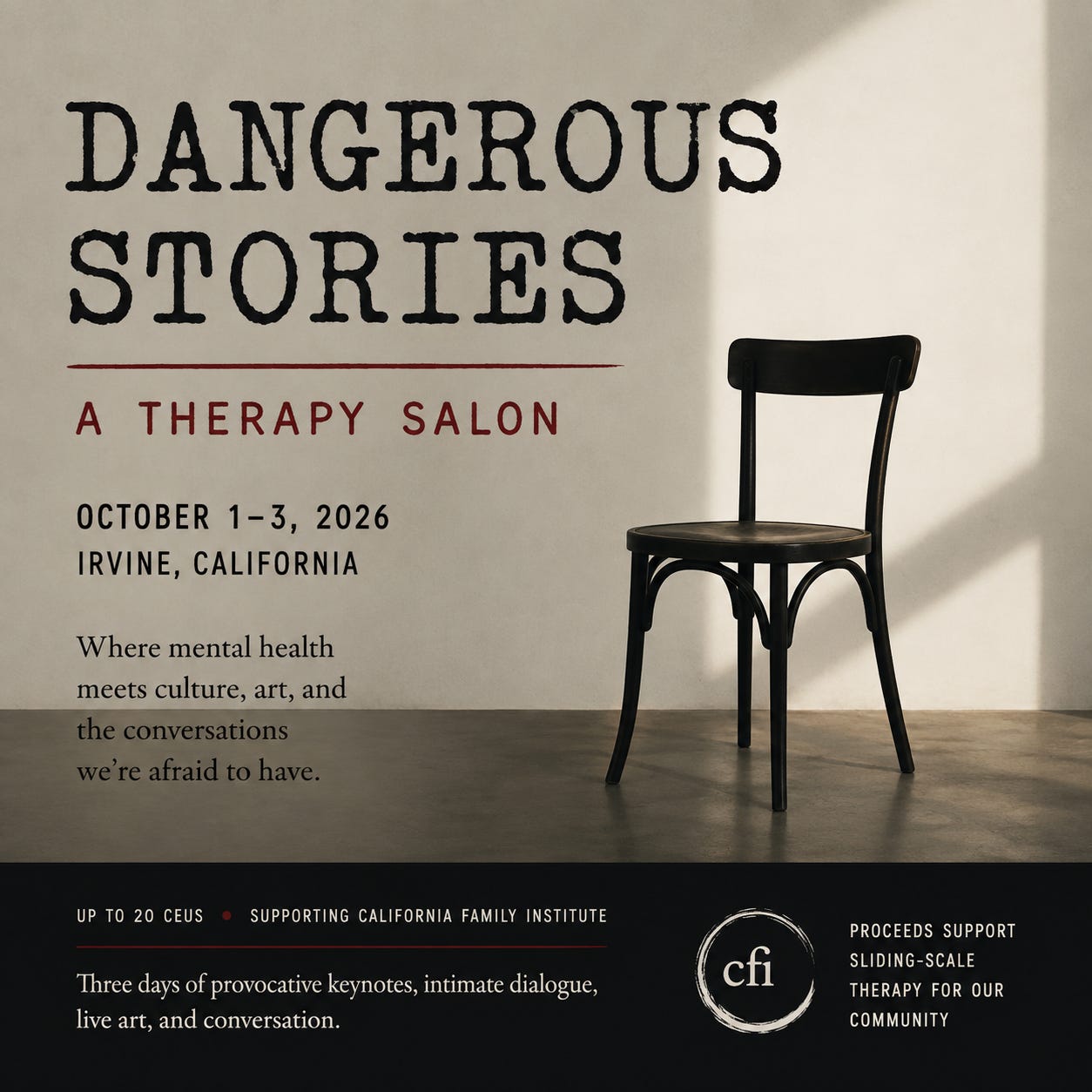
For three days we’ll gather therapists, scholars, artists, writers, and curious people who are willing to ask questions that don’t always fit comfortably within the profession. Together we’ll explore the cultural, political, ethical, and relational stories that shape helping work today, not through certainty, but through conversation.
This isn’t another conference built around techniques or clinical formulas. It’s a salon: a place for ideas, disagreement, creativity, and the kind of encounters that can change how we think and practice.
Every registration also supports California Family Institute’s nonprofit mission of providing affordable, sliding-scale therapy to individuals, couples, and families who might otherwise go without care.
I’d love to see you there.
October 1–3, 2026
Irvine, California
Learn more and reserve your place here: https://www.californiafamilyinstitute.org/dangerous-stories/
Thank you. This one is going to sit with me a while.
Thank you Chris - this was a beautiful and important piece - it has made me very thoughful about the many clients who are struggling to find their place and their voice in their families of origin. Much appreciated.