
On Creativity, Constraints, and Staying Alive to the World

I’ve been messing around with learning to play guitar for as long as I can remember. It’s been a story of starts and stops for years. In a more recent start I picked up the book How to Write One Song by Jeff Tweedy. I thought it might provide some inspiration. I was right. It was certainly inspiring, but not so much in the way I thought.
It turned out to be one of the better explorations of the creative process that I have read. Something that can be applied across all disciplines not just songwriting.
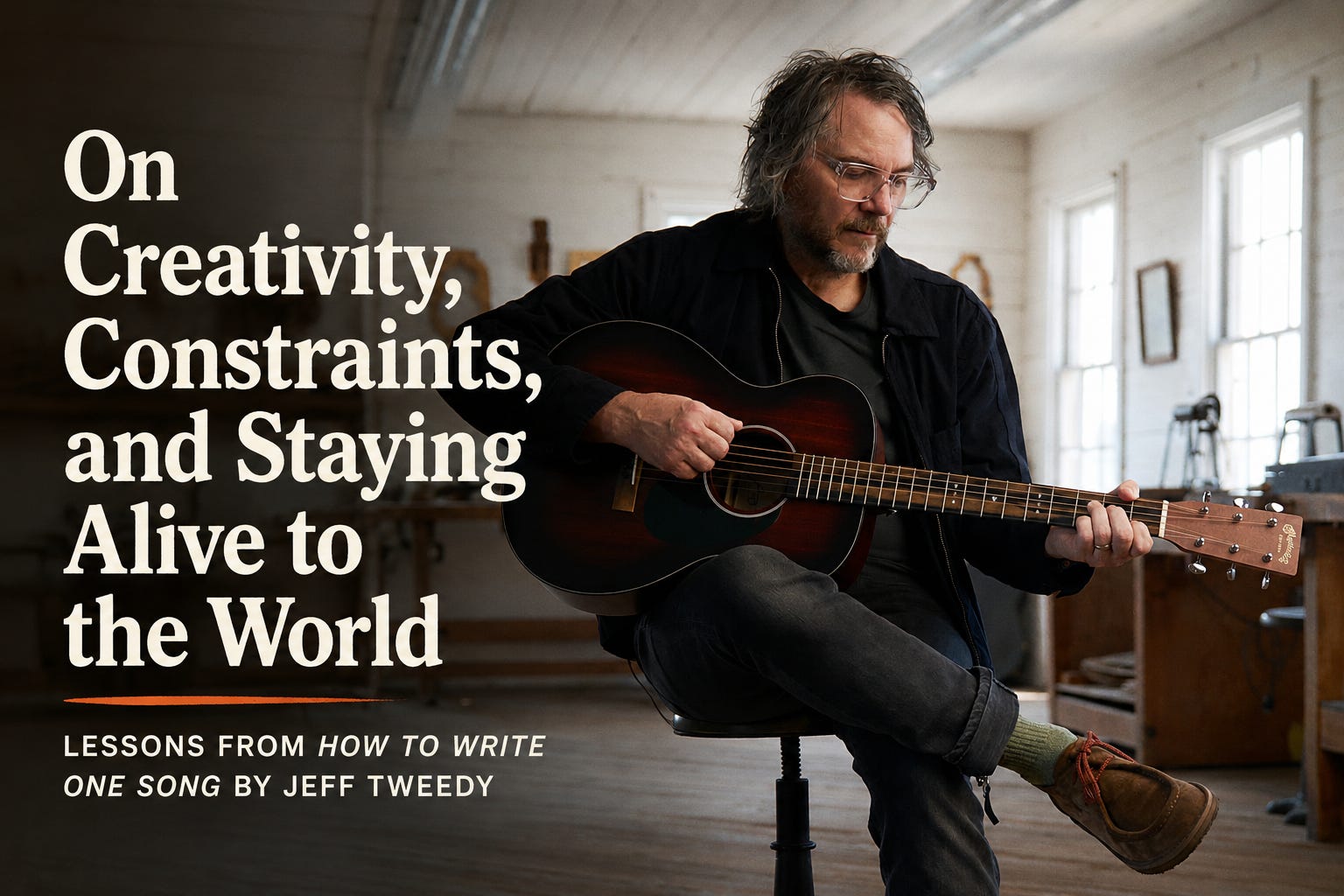
So, I thought I’d share my creative learning’s from the book with all of you:
1. Creativity grows through volume, not preciousness
In the book Tweedy repeatedly argues that the biggest obstacle to creativity is treating every idea as if it has to justify itself. He advocates generating lots of fragments, lyrics, phrases, observations, and experiments without immediately evaluating them. Most meaningful work emerges through accumulation and recombination. In the futuring sprint it’s important that we develop multiple scenarios, and experiment with prototypes for this very reason.
2. Lower the stakes to increase the output
A major theme in the book is that writing one song feels possible, while writing a masterpiece feels paralyzing. Small containers and constraints often create the conditions for movement and experimentation. I recently read David Epsteins new book Inside The Box and it’s helping me rethink some of my own assumptions about the Futuring Sprint. One of the questions I’ve carried throughout this process has been whether the Sprint moves too fast. Four weeks is not a long time. There are prompts, deadlines, structures, limitations, expectations. Part of me wondered if meaningful change was supposed to be slower, looser, more open-ended. But I’m starting to appreciate the value of the container itself.
3. Attention is the real creative resource
Tweedy treats songwriting as a practice of noticing. Creativity is less about inventing from nowhere and more about cultivating sensitivity to language, memory, emotion, and patterns already present in the world. Sorry to bring up the futuring sprint again but, one of the more popular things we do in the sprint is the signal scanning work. In the sprint Signal scanning is a structured practice of deliberately attending to weak signals early, ambiguous indicators of emerging change, rather than waiting for trends to become obvious. In the futuring sprint context, it trains participants to look at the edges of current culture, technology, policy, and behavior for signs that something is shifting before it has a name or a narrative. Which can lead to all sorts of innovative ideas and practices.
4. Ritual matters more than motivation
He demystifies inspiration by emphasizing routine. Creative identity emerges through recurring behaviors such as journaling, note-taking, walking, reading, and showing up consistently to the work. Again, why I think containers are important.
5. The subconscious needs material to work with
Tweedy talks about collecting words, phrases, and images almost like composting. Breakthroughs often come from accumulated input rather than sudden inspiration. One of the things I that I think I am legitimately strong at is curiosity across all sorts of domains. This has been a profound practice in my life and work. Go to a museum or gallery. Go to an artist talk or book reading. Go to a salon.
6. Play is not optional
Play is not my strong suite, but Tweedy argues that word games, free association, absurd combinations, and experimentation are not distractions from creativity. They are central to it. Playfulness allows originality to emerge. Maybe I can find more room for more play in my life..
7. Identity can become a creative trap
You do not need to fully ‘be’ a writer, artist, or creative before beginning. People become writers by writing and thinkers by thinking publicly over time. This is where my rebel nature has proved helpful. I never gave much thought about the gatekeeping of many creative endeavors. Start a gallery with no experience, sure! I’ll do that. Make art with no art education, done. There have been several projects in my life where I just started. And it was the best thing I did.
8. Creativity is relational
One of my friends often tells me one of the more helpful things I told her was that, “there’s nothing new under the sun.” Tweedy also agrees that nothing is purely original. Creative work emerges through contact with culture, memory, influence, and other people. Creativity is often compositional rather than purely inventive. Drop the creative genius narrative and get to work.
9. Finishing matters more than fantasizing
This is one of the hardest for me. I have often referred to myself as “a sprinter in the game of life.” I was good at starting, not so good at finishing. Tweedy argues that unfinished projects often preserve fantasy. Finished projects create growth. Completion teaches structure, pacing, editing, endurance, and release. I’m working on it. It’s my biggest challenge.
10. Creative work is a way of staying alive to the world
Underneath the practical advice Tweedy dispenses is a deeper philosophy: creativity is a mode of participation in life. Making things helps resist numbness, passivity, and repetition.
My wife plans to retire in a couple of years. The plan is to live part-time in Europe (she has Italian citizenship). As this date is getting closer, I am getting more reflective on what retirement might look like for me. What is showing up is that I don’t think I can retire in the traditional sense. It’s not that I’m wedded to the grind. It’s more about not wanting to stop creating. I don’t think I can not be involved in creative projects, ever. More on that as it develops. It’s starting to feel like my 9th mid-life crisis.
Anyway, it might serve you well to Check out How To Write One Song by Jeff Tweedy. How to Write One Song is less a manual for songwriting and more a philosophy of creative practice. Its lessons apply broadly to writing, therapy, leadership, art-making, teaching, entrepreneurship, and any practice that requires sustained imagination and participation in the world. Good stuff.
Peace.
Curious about the Dangerous Stories Virtual Futuring Sprint? I put together this explainer video to show the process. Let me know if you have any questions or would like to participate.
The Sprint
· Four Sunday sessions: June 21, June 28, July 12, and July 19
· 9:00–11:00am PST (we’re skipping July 5th — take the holiday)
· Asynchronous work between sessions (roughly 2–3 hours per week)
· 15 participants maximum
· $699
These are fantastic points, thank you for summarizing! I've worked in a creative industry for a couple decades and, ironically, there are quite a few if not a majority of these points that they manage to drill out of you in the name of efficiency and good business. I will try to stay alive creatively! Thanks for the reminder.
Funny! A musician friend of mine just gave me this book. 🙂