
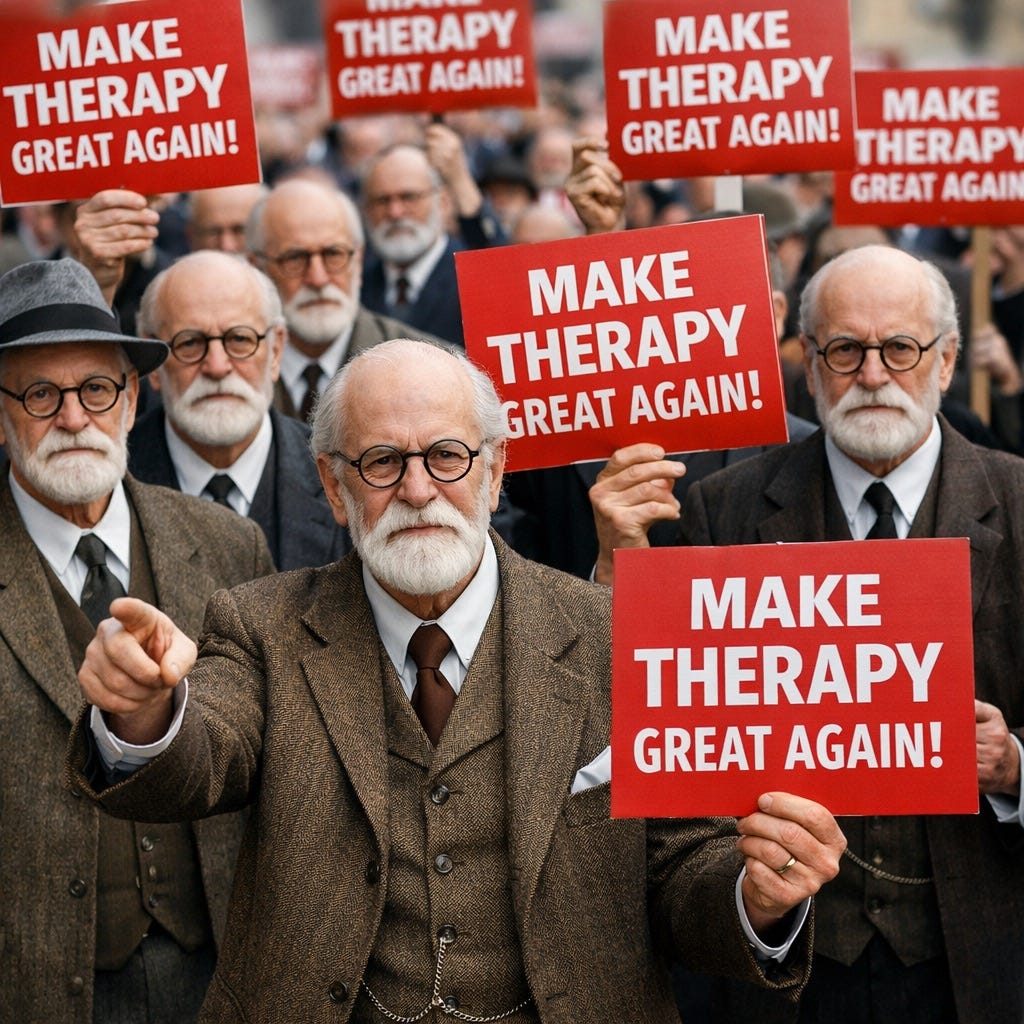
Make Therapy Great Again: The Coerciveness of Professional Nostalgia

I’ve been hearing it more and more in professional circles, complaints from therapists about how we need to get back to when therapy was “real,” when we did “the deep work,” when outcomes actually mattered. You know, the golden age. Except there was no golden age.
The research is unambiguous on this point. Therapy’s outcomes today are statistically identical to the outcomes from therapy’s supposed glory days. Same effect sizes. Same percentages. Same limitations. What we’re witnessing isn’t a decline in therapeutic efficacy, it’s the rise of a nostalgic narrative that functions to keep therapists from engaging with the present challenges of our field. This matters because nostalgia isn’t neutral. It’s coercive.
The Nostalgia Trap
In my practice, I’ve noticed that people come to therapy wanting to talk about two major themes, experiences that have already happened or experiences they haven’t had yet. Rarely do they arrive ready to engage with what’s actually here, at the threshold of now.
Therapy culture is now so dominant that even first-time clients will sit on my couch already scripted, assuming I want to hear stories from their past. Many of these stories carry real pain, yes. But just as often, they’re wrapped in nostalgia and sentimentality, a warm bath of “remember when” that feels good in the moment but prevents any real movement.
While nostalgia and sentimentality can offer comfort and even pleasure, they also keep us stuck. When we’re constantly reminiscing about the past or longing for what used to be, we miss the opportunities and experiences right in front of us, at the threshold.
Now here’s the uncomfortable part, therapists are doing the exact same thing.
The Professional Plot Twist
When therapists talk about returning to “real therapy,” what they’re actually doing is retreating into a nostalgic narrative that protects them from having to reckon with present realities:
That therapy has always been culturally contingent, not universally effective
That our field has dispersed into ambient culture and we need new frameworks for what that means
That the therapeutic paradigm itself is being questioned, not just our techniques
That clients today are navigating complexity we haven’t been trained to address
The nostalgia for a therapeutic golden age functions exactly like individual nostalgia in session, it’s a refusal to be present to what’s actually happening. It’s a way of saying “I don’t want to do the hard work of re-imagining my practice, so I’ll just insist we go backwards.” This is coercive because it shuts down inquiry. It forecloses the future. It positions any critique or evolution of the field as betrayal rather than adaptation.
Good Intentions Aren’t Enough
Look, I get it. The history of therapy is full of good intentions. Dedicated practitioners trying to help people. Theories developed with care. Honest attempts to reduce suffering. But good intentions aren’t the same as a golden age. They never were.
What we’re facing now isn’t a crisis of lost efficacy, it’s a crisis of relevance. The therapeutic paradigm is being challenged not because we’ve strayed from some pure form, but because the cultural conditions that made therapy legible as a solution are shifting beneath us. We can either meet that shift with curiosity and adaptation, or we can retreat into nostalgia and insist everything was better before.
The Threshold Question
So here’s my question for my fellow therapists, what opportunities are we missing right now because we’re too busy longing for a past that never existed?
What would it mean to actually show up to the present moment of our field, with all its messiness, all its uncertainty, all its possibility?
Because if we can’t do that, how can we possibly help our clients do the same?
The threshold is here. It’s always been here.
Time to stop looking backwards.
Personally, I don't hear these laments in the spaces I am in. The focus is more on deconstructing and reimagining the tools forged in bedrock theory, into new applications and forms... the ideas are emergent in weaving new ways that include the body, the mind, the soul, the past, the past as present and the singular now as encompassing past, present and future. At least, that's how I am holding some of these ideas. I do find the echo chamber of bite sized self diagnosis and scripting very tiresome, and the product of a generation rooted in tech consumption which includes being consumed by tech. Much in the way you describe your patients, armed with their stories of the past, folks are armed/defended with diagnosis and symptoms that leave little room for inquiry. And thus the unwinding begins. The "past" is critical, as it informs our perceptions of the present. Telling our stories, and how they are held, is a fundamental part of the work in helping us see the present in its aliveness and potency. Same could be said of our current politic. Thanks for sharing your insights and questions Chris!
I deeply appreciate your keen insights to our profession. I became an LPC in 2020 after 30 years as a football/baseball coach and now really new to the profession. Your wisdom and insight is extremely helpful as I am still an apprentice in the field of counseling and desiring to master my craft as a therapist. Thank you.