
Long Work in a Short Culture
On Reclaiming the Space-Time of Therapy

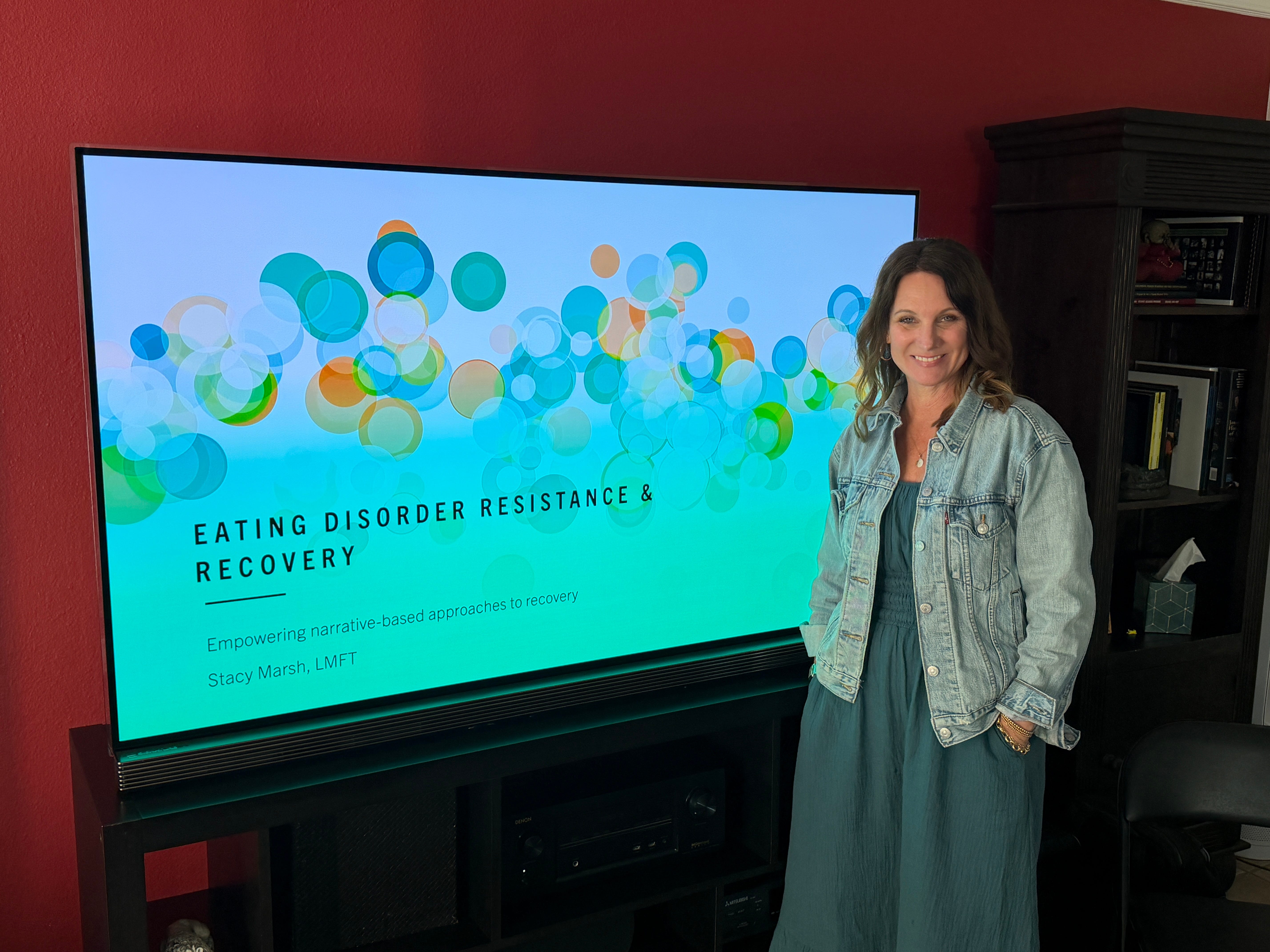
At our most recent Narrative & Pizza, the wonderful Stacy Marsh (who will be presenting at Dangerous Stories in Oct.) presented her work on resistance and recovery from eating disorders from a narrative therapy perspective. At one point she began describing the work in terms of Year One and Year Two. I was struck. Not because I hadn’t thought about therapy unfolding over years. I have. Most have. But hearing it spoken so matter-of-factly felt almost subversive. There was something refreshing to me about refusing to compress the work into weeks or months. After the presentation I found out I wasn’t the only one who had been struck by it. Others mentioned that hearing therapy described across years had landed with them too.
This got me thinking. When did we stop talking about therapy this way?
I suppose part of the answer starts with managed care. When therapy increasingly became organized around reimbursement schedules, treatment plans, measurable outcomes, and evidence-based protocols that promised efficiency. Economic realities demanded shorter episodes of care. This is when we learned to speak the language of interventions instead of journeys. But I don’t think that’s the whole story.
Therapy also entered into an unholy alliance with the medical model. I mean, that started with Freud. Increasingly over time problems came to be understood like hospital admissions: identify the pathology, administer the treatment, discharge the patient as quickly as possible. If a hospital stay shouldn’t last more than a few days, perhaps therapy shouldn’t last more than a few sessions. The metaphor quietly changed.
However, more recently another force has entered the room.
There’s a meme making the rounds on TikTok and Instagram. It goes “Why are therapists becoming influencers? Because influencers are becoming therapists.” It’s funny because there’s truth to it. The influencer economy rewards certainty, speed, simplification, reduction, and hot takes. It’s all done in thirty seconds. Three tips. Five signs. Seven hacks. In this world attention is the currency, and attention demands acceleration. The danger here isn’t simply that therapists make videos. It’s that in these videos we begin importing the logic of the platform into the practice of therapy. That is a deal with the devil. Everybody loses. Clients begin to imagine that insight should arrive quickly, healing should be visible immediately, and suffering that persists represents failure. Therapists, meanwhile, begin feeling responsible for producing rapid movement every session. Let the influencers be influencers. This is a dangerous game for therapists.
I’ve also been wondering if what we’re witnessing is more than a change in expectations. Perhaps it is a collision between different experiences of time itself. Mikhail Bakhtin used the word chronotope to describe the inseparable relationship between time and space. Every human practice, every institution, every culture lives within its own chronotope. The courtroom has one. The classroom has one. Social media certainly has one. Therapy has one too.
The therapy office isn’t simply a room where conversations happen. It is a particular space-time. A world with its own rhythms, tempo, its own possibilities. The problem is that other chronotopes are invading it. The chronotope of managed care is, “How quickly can this be resolved? The chronotope of medicine is, “What diagnosis explains this, and what intervention treats it?” The chronotope of social media is, “Can this be summarized into a reel?” The chronotope of late capitalism asks, “How can this be optimized?” Each of these carries its own assumptions about progress, success, and how long transformation should take.
Therapy, when it’s at its best, asks something different.
Good therapy makes room for stories that cannot be rushed. For identities that come together unevenly. For people who move forward, then backward, then sideways. It allows confusion to remain confusion for a while. It allows silence to do some of the work. It allows a conversation to matter even when nothing appears to have changed by the end of the hour. These are not inefficiencies. They are the conditions under which many forms of change become possible.
Today many clients arrive never quite alone. They are accompanied by the tempo of the culture. Productivity. Optimization. Algorithms. Fragmentation. Self-improvement. The expectation that every problem should yield to the right technique if only we could discover it. Unfortunately that urgency doesn’t stay outside the office. It enters the room, sits in the empty chair, and quietly begins directing the conversation. And what I know about urgency, it isnt long before it has recruited the therapist as well. Urgency is a shitty therapist.
This all has me now thinking one of the ethical responsibilities of therapy today is to protect a different experience of time. Not because longer is always better. Not because endless therapy is the goal. Because there are transformations that are not going to happen on demand. There are stories that cannot be edited into thirty seconds. There are identities that need seasons rather than solutions. And perhaps there is something even more important at stake.
Narrative therapy has never been about solving problems. It has always been about composing lives. A life is not repaired the way a machine is repaired. It is authored. Revised. Interrupted. Reimagined. Futures are not discovered waiting for us somewhere ahead. They are composed through conversations, relationships, experiments, setbacks, acts of courage, and moments of recognition that accumulate over time. This is why therapy needs its own chronotope. Not simply because healing takes time. But because futures do.
A possible future cannot be rushed into existence any more than trust, intimacy, grief, forgiveness, or wisdom can. They require incubation. They ask us to linger with uncertainty long enough for something genuinely new to emerge. Perhaps one of the quiet tasks of the therapist is not to help people solve the problems of the present, but to protect the temporal conditions under which different futures can become imaginable.
Maybe the future of therapy isn’t simply better techniques, better management, or better videos on TikTok. Maybe it is recovering and defending its own chronotope. Its own space-time. A place where people are permitted to become, rather than simply improve. To say, without apology, “This may take a year.”
Or two.
Peace.
Have you registered Yet?
Not a conference. A salon.
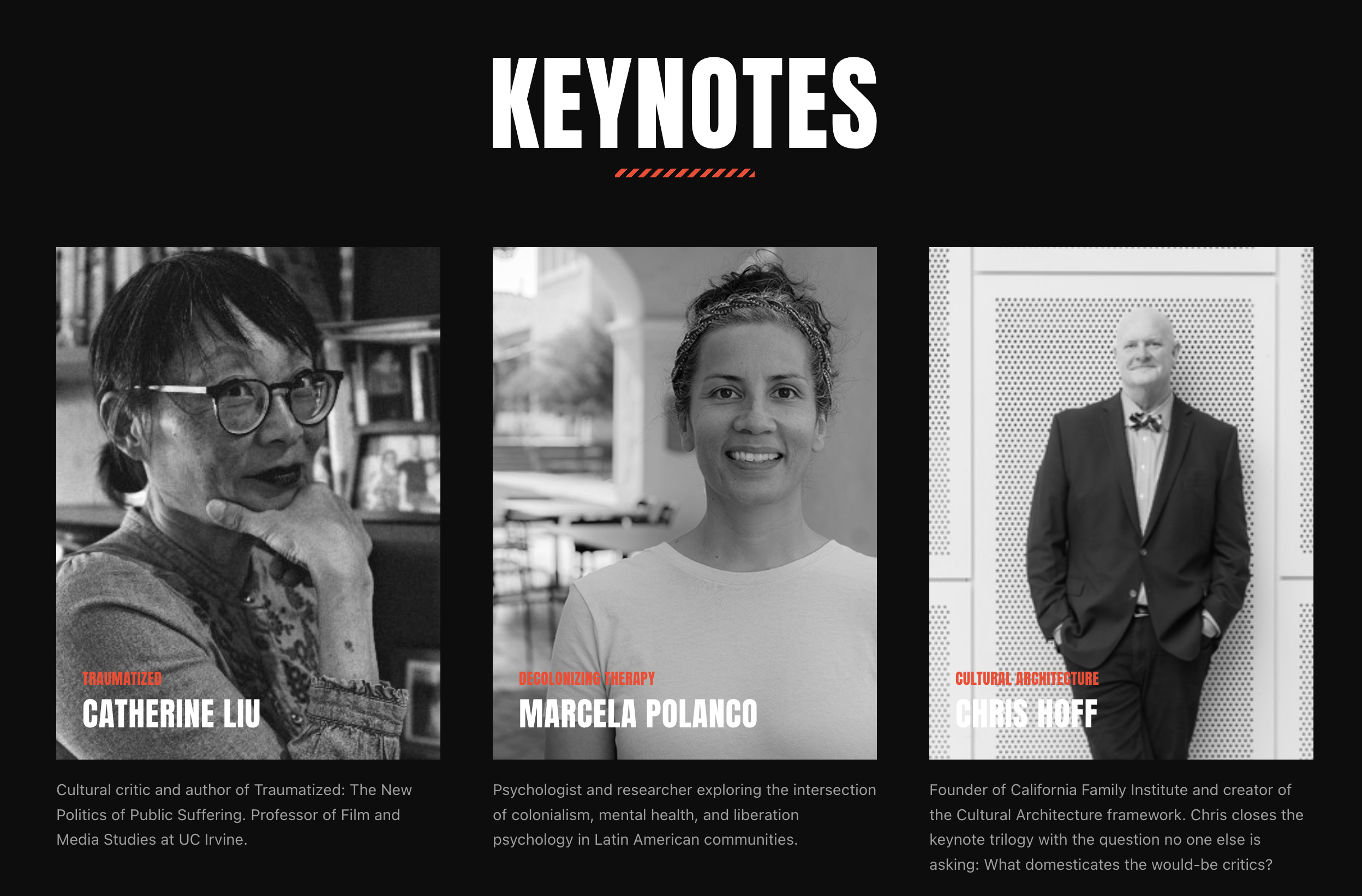
Three days of provocative keynotes, intimate dialogue, and live art with therapists, cultural workers, and thinkers pushing beyond the usual scripts.
Tired of boring conferences? This is your moment.
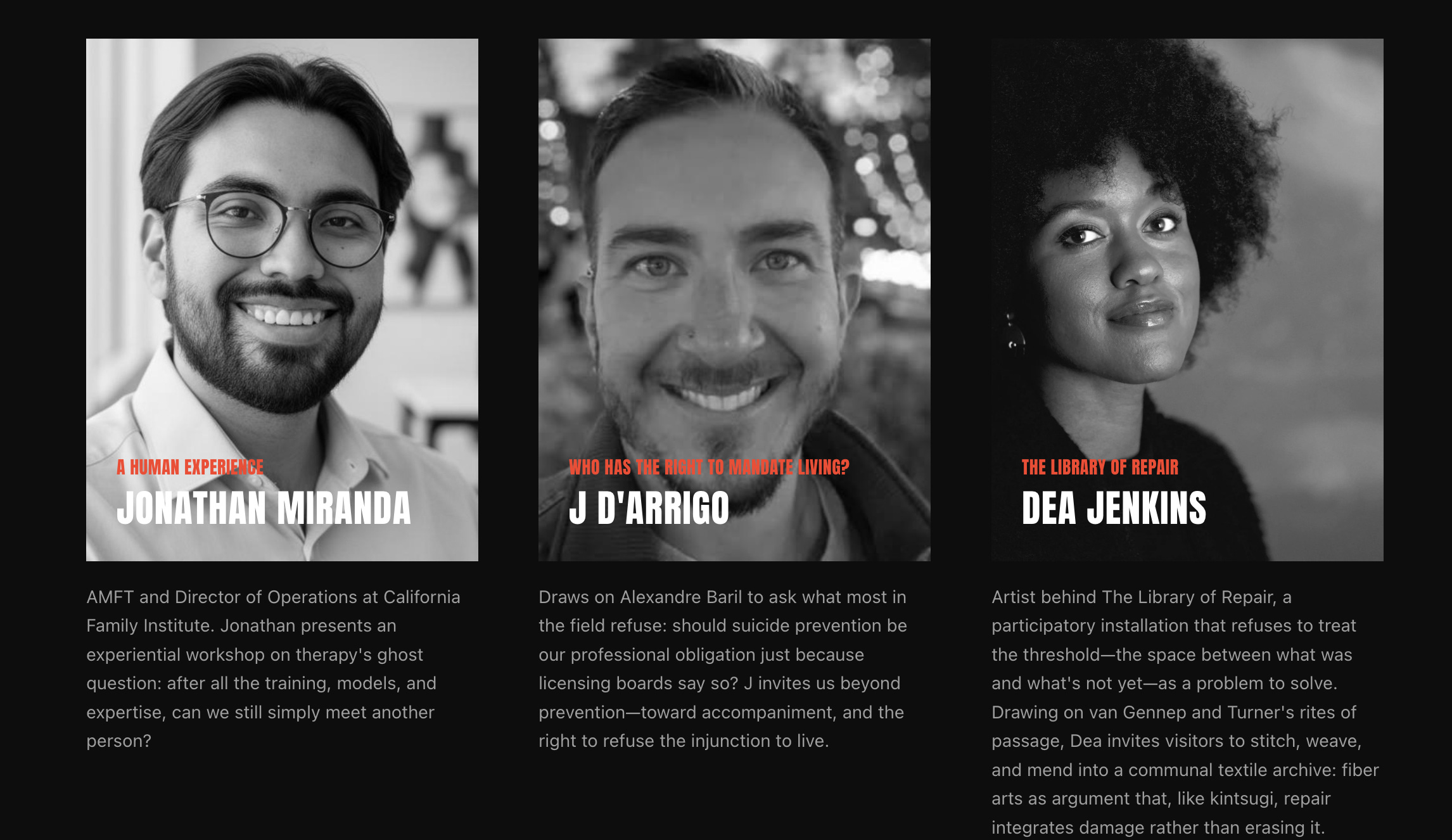
Dangerous Stories: A Therapy Salon
October 1–3 · Irvine, CA
This is where therapy stops playing it safe.
(All funds support California Family Institute, CEU’s available!)
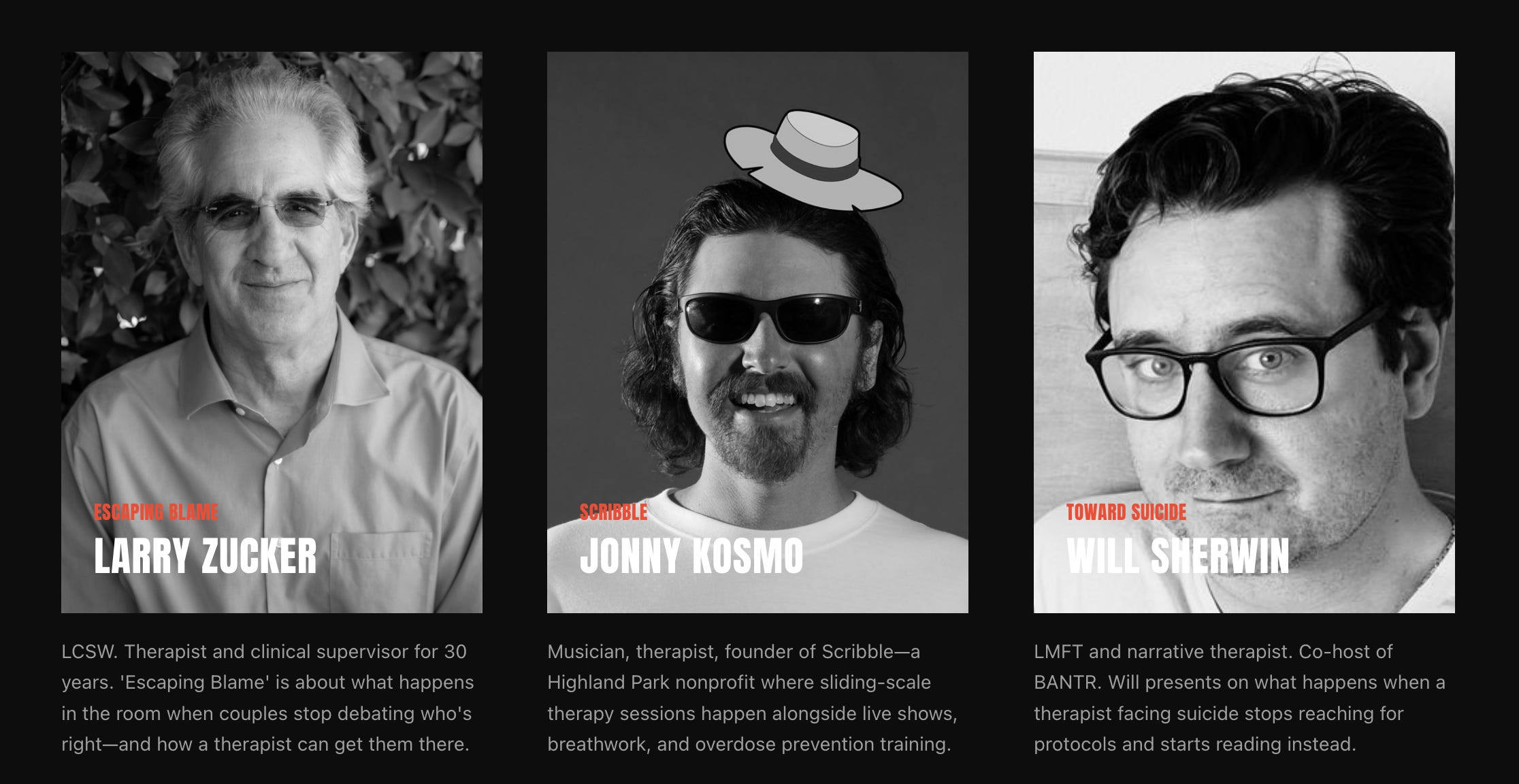
More speakers coming!
🎟 Grab your spot: https://www.californiafamilyinstitute.org/dangerous-stories/
Many years ago, my therapist told me that a goal of my treatment was to build a life worth living. I don't think that description was original and have heard it since, but it has always stuck with me. I used to think of our sessions as the only thing in my life that was truly for me. It was sacred time and sacred space. And boy, healing took many years. I'm still healing, but more importantly, I have been steadily building a life worth living.
Rushing is one of my red flags and I can see how it has entered the therapy room with me as a patient. Fix me and do it quickly. Two errors- you fix me and do it now. Or maybe three errors. Add in non-acceptance of where I am in the moment.
The $200 per hour out of pocket that I paid really added to the urgency. I am not willing to retell that story. It will take me 5 minutes. The financial calculator in my heads computes how much financial cost is involved and doesn’t like the answer. And, I can see how a therapist might rush if the patient’s insurance only allows 10 sessions or whatever the number is.
And, culture. Rushing, rushing, rushing.
I wish “attention” could find a substitute word in your article. Pure attention is what I am striving for. Awareness. The attention you refer to is the publicity type. At least, that is how I see it.